
Choosing the best microphones for conference rooms, classrooms, and auditoriums is essential for clear communication. Whether you are supporting hybrid meetings, distance learning, lectures, assemblies, or live events, the right microphone systems help every voice sound natural and easy to understand. A strong microphone plan starts with room size, seating layout, acoustics, number of speakers, and whether audio will be used for in-room amplification, video conferencing, recording, streaming, or all of the above.
Conference Room Microphones for Hybrid Meetings
For meeting spaces, conference room microphones must capture voices evenly for both in-room and remote participants. Small huddle rooms may only need a USB speakerphone or tabletop microphone with 360-degree pickup. Medium and large conference rooms often require microphone arrays, ceiling microphones, or multiple tabletop units placed across the table.
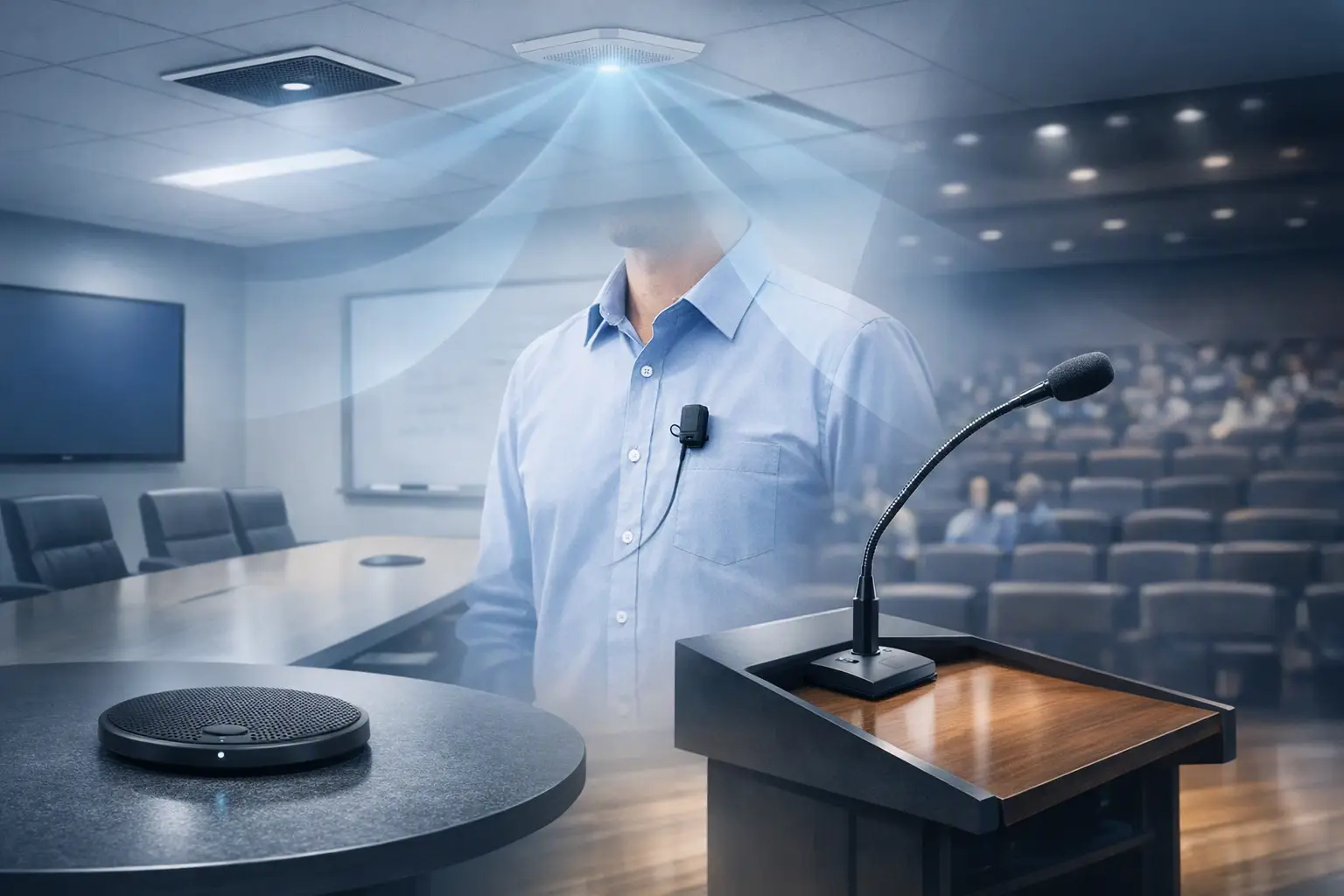
Beamforming ceiling microphones have become a favorite of Acuity Audiovisual customers for medium and larger conference rooms. The ability to define ‘beams’ of audio pickup or cancellation improves overall audio input by focusing on active speakers and muting room noise like HVAC systems, keyboards and side conversations. They also can provide location information for who is speaking back to the control system so that cameras can be automatically adjusted to the active speaker using Automatic Camera Preset Recall (ACPR). This automatic control mechanism provides a much more productive experience for far side participants, since they can always see who is speaking.
For executive boardrooms, training rooms, and divisible spaces, a professionally designed microphone installation with ceiling arrays and digital signal processing can deliver cleaner, more consistent audio.
Classroom Microphones for Teaching and Hybrid Learning
Classroom microphones solve a different set of challenges. Teachers move around, students ask questions from different seats, and lessons may be recorded or streamed for remote learners. A wireless lavalier microphone or headset microphone is often the best microphone for teachers because it keeps the instructor’s voice consistent while they write, demonstrate, or move through the room. For student participation, beamforming ceiling microphones are a popular choice, but boundary microphones, or hanging microphones are other options for capturing questions without passing a handheld mic.
In many hybrid classrooms we integrate beamforming ceiling microphones with wireless microphones for instructors and presenters. The presenter microphones can be added to the ACPR design so that presenters can be prioritized in the audio mix and camera control.
In education environments, reliability and ease of use matter nearly as much as audio quality. Classroom AV systems should power on quickly, connect reliably, and require minimal adjustment. Rechargeable wireless microphones, simple wall controls, and automatic mixing help teachers focus on instruction instead of technology.
Auditorium Microphones for Lectures, Panels, and Live Events
Auditorium microphones require careful planning because larger rooms need both speech reinforcement and feedback control. Lecterns typically pair well with gooseneck microphones, while presenters, performers, and guest speakers may need wireless handheld, lavalier, or headset microphones. Panel discussions often benefit from multiple, wireless handheld, tabletop or gooseneck microphones connected to an automatic mixer so each speaker can be heard clearly, although beamforming ceiling microphones can be used for panels in the right conditions.
For auditoriums, microphone choice should be coordinated with loudspeakers, room acoustics, stage layout, and the event schedule. Directional microphones are useful because they focus on the speaker and reject unwanted sound from the audience or sound system. This helps reduce echo, ringing, and muddiness during assemblies, lectures, worship services, performances, and community meetings.
How to Evaluate Microphone Systems for Your Space
When evaluating the microphone recommendations from your AV designer or integrator, start by ensuring the selection matches your vision for the room. Will the number and type of microphones fully cover the room so that each participant can be heard in the room and on the far side of a video call? Ensure this is the case for every common room configuration.
As an audiovisual integrator we measure the space, identify reflective surfaces, and do the math to build the right system…as we understand the room use. We spend most of our time in the survey process ensuring that we fully understand how the room is currently used, as well as, thinking through how the room may be used in the future.
Our common goal is simple: everyone should be heard clearly, whether they are sitting at a conference table, teaching from the front of a classroom, or speaking to a full auditorium. With the right conference room microphones, classroom microphones, or auditorium microphones, communication becomes clearer, meetings become more productive, lessons become more accessible, and events feel more professional from the first word to the last.
Ready to Improve Your Room Audio?
If you are planning a conference room upgrade, classroom AV installation, or auditorium sound system refresh, the right microphone strategy can make all the difference. Contact us for an assessment of your space and a system design that delivers clear, reliable audio for every speaker and listener.